
- Research
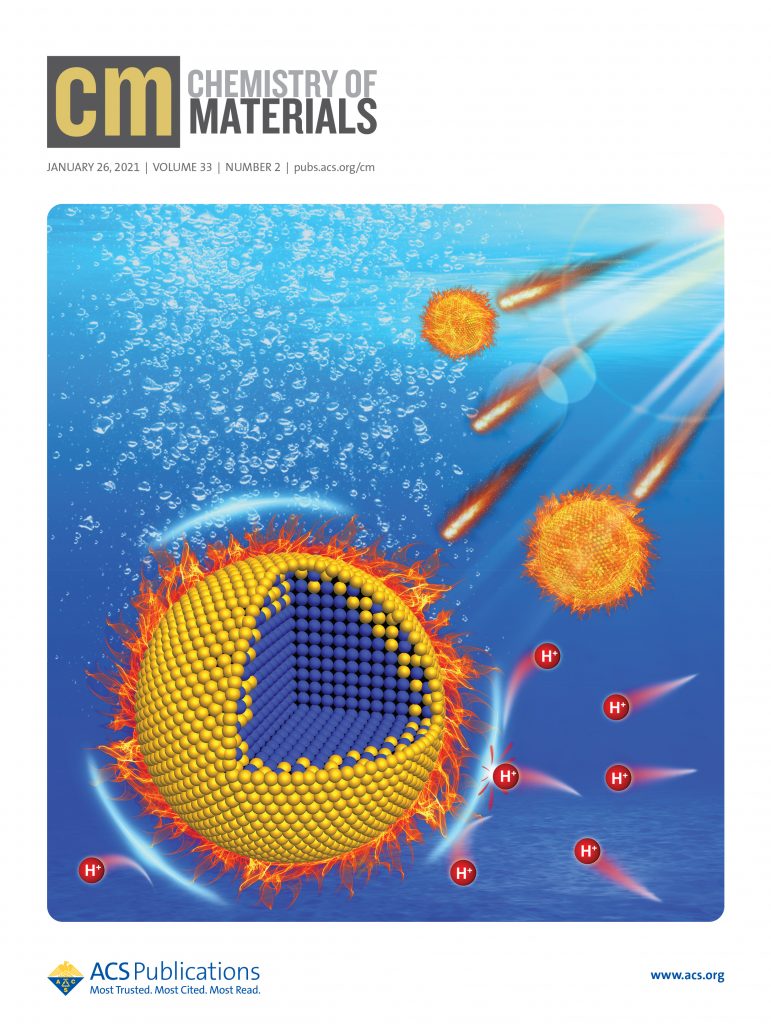
An INRS discovery made the cover of the journal Chemistry of Materials’ January 2021 issue.

The Institut national de la recherche scientifique (INRS) researchers, directed by Professor Dongling Ma, in collaboration with Professor Mohamed Chaker, achieved a very high chemical stability for copper-based nanoparticles (Cu NPs) using a simple, yet effective, method.
They are the first to demonstrate the key role of a robust compact gold shell in stabilizing Cu NPs. “Although people previously reported the use of inert metals to protect copper, never such a strong stability has been reported”, says Professor Ma, Chairholder of Canada Research Chair in Advanced Functional Nanocomposites and leader of the Nanomaterials Chemistry and Advanced Optical Characterization Lab.
A metal with many applications
As a low-cost and earth-abundant non-noble metal, copper nanoparticles have received increasing attention for their strong and broadband absorption. However, the easy oxidation and leaching of copper seriously affect their application. With the gold shell, having excellent oxidation resistance, the team was able to maintain high chemical stability and performance under harsh conditions, such as the presence of strong oxidizing acid.
These highly stable Cu-based nanoparticles can find many promising applications, such as seawater desalination, photocatalysis, solar energy harvesting, optoelectronics, plasmonics, molecular sensors and computer chips. Their next step will focus on scaling up the synthesis.
“We are quite excited and also very pleased to know that the significance, novelty and value of our work is well recognized among scientists in material chemistry,” she says.
About the Study
The paper “Ultrastable Plasmonic Cu-Based Core−Shell Nanoparticles”, by Yong Wang, Qingzhe Zhang, Yongchen Wang, Lucas V. Besteiro, Yannan Liu, Haiyan Tan, Zhiming M. Wang, Alexander O. Govorov, Jin Z. Zhang, Jason K. Cooper, Jing Zhao, Guozhu Chen, Mohamed Chaker and Dongling Ma, was published in the journal Chemistry of Materials. The study received financial support from the Natural Sciences and Engineering Research Council of Canada (NSERC) and the Fonds de recherche du Québec – Nature et technologies (FRQNT).
You may also like

February 10, 2021
Nanomaterials to decontaminate water

February 10, 2021
A promising breakthrough for a better design of electronic materials