
The only facility of its kind in North America, the Environmental Hydraulics Laboratory simulates waves, tides, and strong currents to help researchers develop sustainable coastal management strategies for controlling erosion caused by climate change.


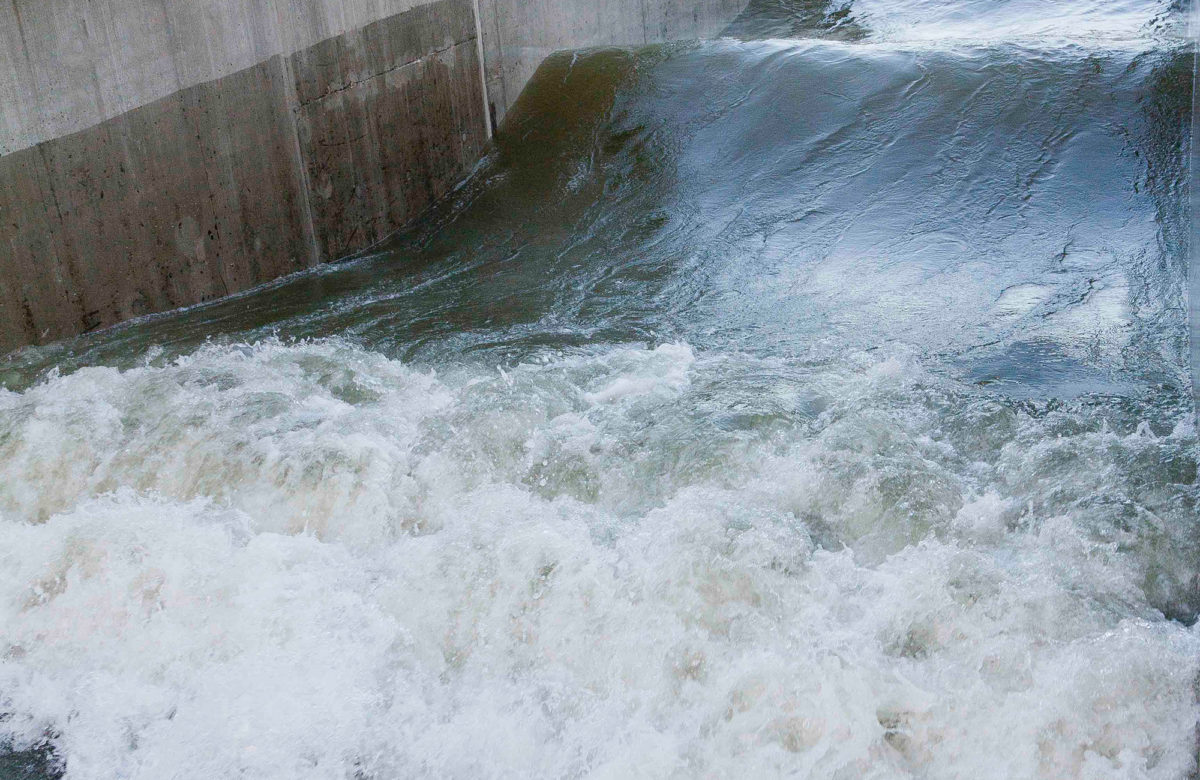

The large-scale multipurpose wave flume (120 m long, 5 m wide, and 5 m deep) can be used to simulate for example high-amplitude waves and tsunamis caused by landslides and earthquakes.
Located in the Québec Metro High Tech Park, the wave flume is 120 m long, 5 m wide, and 5 m deep. It extends 4 m underground and 1 m above ground. Waves generated can reach the top of the flume walls and be produced in depths ranging from 2.5 to 3.5 m and wave periods of 3 to 10 seconds.
In addition to a mobile walkway, a gantry crane, and a series of equipment decks, the wave flume is also equipped with:
- a wavemaker
- a draining and filling system connected to a 3500 m3 reservoir
- a two-way water flow system
- measuring equipment (current, turbidity, water level, topography, etc.)
Data acquisition systems
14 National Instrument CompactRIO systems, each with 256 analog inputs and 8 modules with sampling rates of 250 kHz. The modules have 32 channels each. They are spaced 5 m apart along the flume, with the first one 45 m from the wave generator.
Current measurement
- 2 Sontek 3 MHz Mini-ADPs
- 2 Nortek 2 MHz Aquadopp HRs
- 10 Nortek Vectrino ADVs
- 3 Nortek Vectrino II ADVs
Turbidity measurement
- 24 OBS 3+
Water level sensors
- 18 RBR-Global WG-55s
Topography and bathymetry
- 1 Imagenex 675 kHz multibeam profiling sonar (model Delta T 837B)
- 1 Imagenex 260 kHz digital multibeam imaging sonar (model 965)
Cameras
- 1 DeepSea Multi SeaCam (underwater)
- 2 DeepSea Seasnake SS-30C (underwater)
- 1 DeepSea Multi SeaLite (underwater)
- 2 mobile HD security cameras
- 1 wireless security camera
- 1 fixed HD security camera
70 strain gauges
- Barometric pressure sensor: 1 RM Young
Pressure sensors
- 5 Kistler sensors, model 4073A50 (max. pressure: 12500 kPa)
- 22 PCB sensors, model 113B26 (max. pressure: 6895 kPa)
- 25 GE UNIK5000 sensors
Institut national de la recherche scientifique (INRS) also has a smaller-scale wave flume with an electronically controlled wavemaker. The small flume is sometimes used to scale down experiments before they are carried out in the big flume. It has been designed to accommodate the same type of measurement devices as used in the main flume. Learn more
The Environmental Hydraulics Laboratory offers research services to other universities, as well as to industry and government in the following research themes (also see Applications).
Fluid dynamics
- Fluid physics
- Fluid mixing
- Multiphase flow
- Digital methods
Oceanography and atmospheric sciences
- Wave physics
- Wind physics
- Atmosphere/ocean interaction
- Wind- and tide-generated waves
- Wind-induced coastal processes
- Wave- and wind-driven ice
- Storm predictions
- Extreme waves
- Hydrodynamics of underwater explosions
- Climate modelling
Coastal processes
- Coastal erosion
- Coastal hydrodynamics
- Natural risk predictions
- Storm surges and flooding
- Runup and overtopping
- Sediment transport
- Wave/sediment interaction
- Currents and interaction
- Scouring
- Hydraulic dunes
- Coastal structures
Behaviour of structures
- Marine structures
- Marine vegetation
- Special structures (e.g., underwater vehicles)
- Fluid/structure interaction
- Forces and impact on structures
- Debris flow (ice, wood, objects)
- Flexible structures
- Structural dynamics
- Hydroelasticity and aeroelasticity
- Vibration control
Renewable energy
- Wave energy
- Wind energy
- Tidal energy
- Offshore solar energy
- Biomimetic energy
The Environmental Hydraulics Laboratory offers a wealth of potential applications, for example:
- Model the equilibrium profile of beaches to help stabilize shorelines
- Model sedimentation in ports and marinas to help plan dredging operations and control sediment drift
- Study the interaction of currents and waves on coastal and offshore structures
- Model overflow and overtopping caused by rising sea levels along Canada’s coastline
- Simulate the effects of tides on port facilities
- Simulate the effects of ice on shores in the presence of waves and currents
- Model the dispersion of pollutants in complex hydraulic systems
- Design projects and soft solutions for coastline protection
This $13.5 million facility was funded by Innovation, Science and Economic Development Canada and the Government of Quebec under the Knowledge Infrastructure Program.
Contacts
Damien Pham Van Bang
Professor et Scientific co-head
Phone: 418-654-2590
damien.pham_van_bang@ete.dev.inrs.ca
Jacob Stolle
Professor et Scientific co-head
Phone: 418-654-3115
jacob.stolle@ete.dev.inrs.ca
Dominik Lapierre
Research Officer
Phone: 418-654-3728
dominik.lapierre@ete.dev.inrs.ca
Raky Rezgui
Research Technician
Phone: 418-654-2684
raky.rezgui@ete.dev.inrs.ca
Carole Parent
Partnerships and Research Development Advisor
Phone: 418-654-2531
carole.parent@ete.dev.inrs.ca
Institut national de la recherche scientifique
Laboratories for Scientific and Technological Innovation in Environment LISTE)
Centre Eau Terre Environnement
Québec Metro High Tech Park
2605 blvd. du Parc-Technologique
Québec City, Quebec G1P 4S5
Canada