
The Aquatic Bio-optics and Biogeochemistry Laboratory enables researchers to study the effects of climate change and permafrost thawing on lake water transparency and mixing dynamics and their multiple impacts on the microbial food chain, greenhouse gas emissions, and oxythermal habitat. Research at the Aquatic Bio-Optics and Biogeochemistry Laboratory also focuses on developing optical equipment for early detection of algal and cyanobacterial blooms and other problems related to water browning.


Laboratoire de bio-optique et biogéochimie aquatique à l'INRS

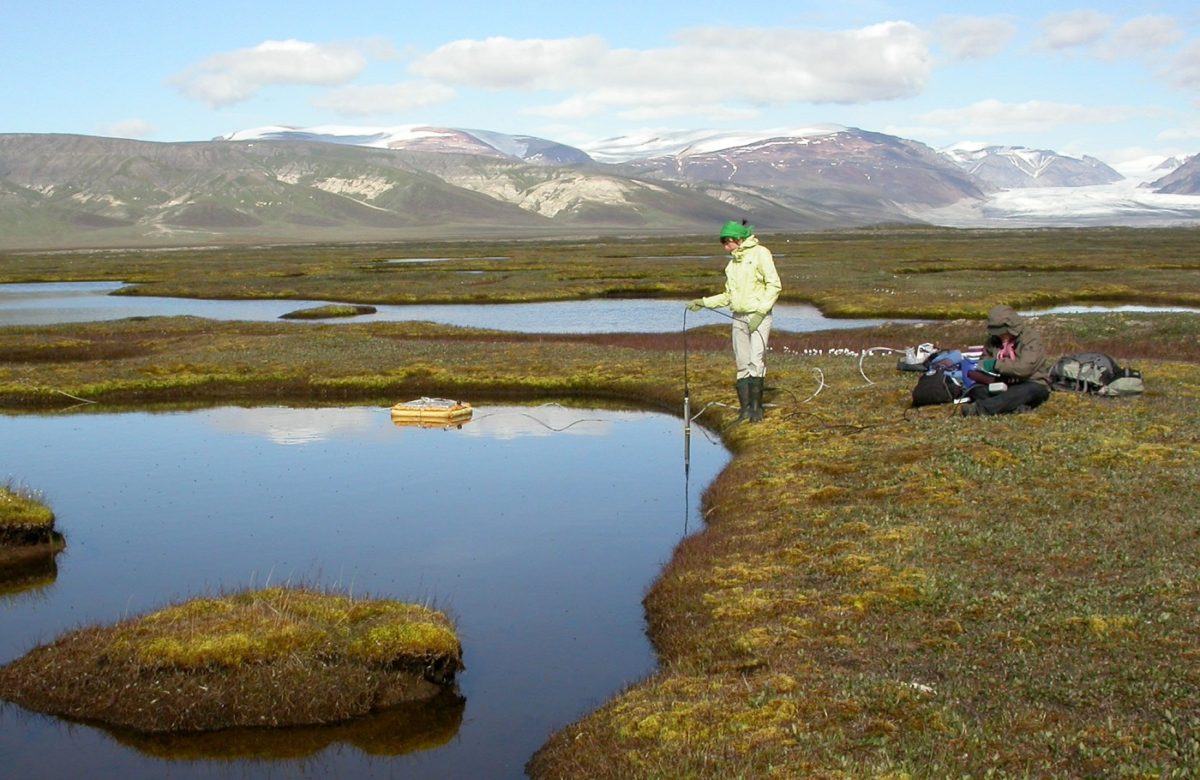
Recherches sur le terrain à l'île Bylot
The Aquatic Bio-Optics and Biogeochemistry Laboratory features the following equipment:
- Flow cytometer (BD FACSCalibur), which analyzes the optical and physiological properties (DNA, pigments, and abundance) of microbial organisms
- FluoroProbe (BBE Moldaenke) used to take in situ profiles of plankton assemblages in aquatic environments (e.g., vertical migration of phytoplankton and rapid localization of cyanobacteria)
- Inverted epifluorescence microscope (Axiovert, Zeiss) for identifying and characterizing plankton species (e.g., natural florescence of phytoplankton and DNA markers)
- PAM fluorometer (Phyto-PAM, Walz) for determining physiological characteristics of photosynthetic organisms such as quantum yield and photoinhibition
- Photometer (MicroPro, Satlantic) used to take vertical illumination profiles at 8 wavelengths in the visible and UV light ranges (e.g., extinction cœfficients)
- Physicochemical profilers (YSI EXO2 and ProODO) for vertical profiling of temperature, dissolved oxygen, conductivity, turbidity, phytoplankton, and dissolved organic matter by fluorescence
- Continuous measurement system for gases dissolved in water (prototype for CO2, CH4, and O2) to estimate greenhouse gas emissions from aquatic systems
- System for measuring CO2 in the air (EGM-4, PP-Systems) and therefore CO2 flows at the water-air interface of lakes and ponds
- Fiber optic dissolved oxygen measurement system (FiBox 4, PreSens) for measuring the rate of oxygen consumption (bacterial respiration)
The Aquatic Bio-Optics and Biochemistry Laboratory is available to faculty, students, and staff of the Eau Terre Environnement Research Centre for their research projects.
The laboratory’s facilities and our expertise may also be used for external collaborations or research and development contracts.
Please contact us for more information.
The Aquatic Bio-Optics and Biochemistry Laboratory supports the work of Isabelle Laurion’s team. Its applications include:
- Counting and characterizing small particles (bacteria, picophytoplankton; flow cytometry)
- Tracking naturally fluorescent microorganisms (cyanobacteria, chlorophytes, diatoms and dinoflagellates, cryptophyes; FluoroProbe)
- Describing their morphometrics and taxonomy (inverted epifluorescence microscope)
- Studying their physiology (PAM fluorometer)
- Evaluating the carbon footprint of aquatic ecosystems
- Conducting limnological diagnoses of water bodies affected by human activity
These instruments (microscope and cytometer) may be combined with fluorescent molecular probes to study prokaryote taxonomy or certain physiological aspects.
This facility is funded by the Canada Foundation for Innovation (CFI), the Natural Sciences and Engineering Research Council (NSERC), and the Fonds de recherche du Québec – Nature et technologies (FRQNT).
Contacts
Aquatic Bio-optics and Biogeochemistry Laboratory
Institut national de la recherche scientifique
Eau Terre Environnement Research Centre
490 de la Couronne Street
Québec City, Quebec G1K 9A9
Canada